project management · May 7, 2025
Collaborative Goal Setting: What Teams Should Know

Last updated: July 20, 2026
Collaborative goals are shared objectives a team defines together, distinct from individual KPIs because every member co-owns the outcome. Without them, teams drift into siloed effort, low accountability, and disconnected motivation. With them, the seven qualities that make a good one (clear, measurable, achievable, relevant, time-bound, transparent, flexible) keep effort focused while still able to adapt as priorities shift.
- What Are Collaborative Goals?
- Why Should Teams Set Collaborative Goals?
- What Happens When Teams Don't Have Collaborative Goals?
- How Do You Set Collaborative Goals?
- What Strategies Help With Setting Collaborative Goals?
- How Does Quire Help Teams Achieve Collaborative Goals?
- What's the Next Step for Your Team's Goals?
- Frequently Asked Questions
Most goals fail not because the goal was wrong, but because the team setting it didn't own it together. A leader writes a target, sends it down, and the people executing read it once and never look at it again. Three months later, individual work has continued and the goal has quietly drifted out of the picture. Collaborative goal setting is what stops that drift; the goal becomes load-bearing when the people doing the work co-own it from the start, not when it arrives in a slide.
The effect of co-owning and tracking a goal is measurable. In a study at Dominican University of California, psychologist Gail Matthews found that participants who wrote their goals down and sent weekly progress notes to a friend reached a success rate around 76%, versus 43% for those who only thought about their goals. Writing it down and sharing it, the core of collaborative goal setting, is what moves the needle.
This post covers what makes a goal collaborative versus handed-down, what teams without collaboration goals lose, the seven qualities of a good one, and the eight-step process for setting one that gets actually pursued past the first sprint. The companion piece on shared team goals covers the broader framing.
Handed-down goal vs Collaborative goal
What Are Collaborative Goals?
Collaborative goals are shared objectives jointly defined by a team to guide their collective efforts toward a specific outcome. These goals go beyond personal performance metrics and instead reflect a unified vision of success that each team member contributes to.
Rather than an individual saying, “I will increase our social media engagement,” a collaborative goal reframes the effort as, “The marketing team will improve social media engagement by 25% in the next quarter.” Now the whole team owns the number, and everyone has a reason to help each other hit it.
Key elements of collaboration goals:
- Shared ownership: Everyone feels accountable for the outcome.
- Cross-functional alignment: Different departments or team members work toward the same result.
- Transparent contributions: Every individual understands their role in achieving the goal.
- Unified motivation: Efforts are concentrated in the same direction, avoiding duplicated or contradictory work.
For example, in a software company preparing for a product launch, a collaborative goal might look like:
“Launch the new feature update by September 15, ensuring a 98% customer satisfaction rate within the first month.”
This type of goal would involve developers (for the update), the QA team (for testing), customer support (to handle post-launch feedback), and marketing (for announcements), with everyone working under a shared objective.
Why Should Teams Set Collaborative Goals?
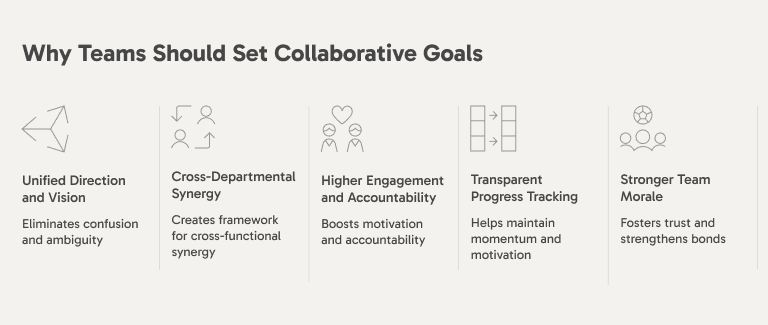
Five outcomes appear consistently in teams that set goals collaboratively rather than receive them top-down. Each one is observable on the team after one or two goal cycles:
1. How Do Collaborative Goals Unify Direction and Vision?
When everyone from leadership to the newest hire can name the team's direction, ambiguity stops eating the calendar. Prioritizing gets easier. Resource questions get easier. Even mid-project decisions get easier, because people can check their own call against the goal instead of booking a meeting about it.
Example: A marketing team with the collaborative goal of increasing lead generation by 25% in the next quarter can focus on high-priority tasks like optimizing landing pages and creating targeted ad campaigns, all aligned toward one common target.
2. How Do Collaborative Goals Drive Cross-Departmental Teamwork?
Left alone, every department optimizes its own scoreboard. Sales chases quota, marketing chases leads, product chases the roadmap, and the larger mission belongs to no one in particular. A collaborative goal gives sales, marketing, product, and support one scoreboard to point at, so coordinating stops being a favor between departments and becomes the job itself.
Example: A product launch that involves marketing, design, and engineering teams can benefit from a collaborative goal, such as launching the product on time while maintaining high-quality standards. This shared goal ensures that marketing communicates product features accurately, design adheres to the brand's vision, and engineering delivers a product that meets expectations.
3. How Do Collaborative Goals Increase Engagement and Accountability?
People fight for goals they helped write. It's that simple. When your fingerprints are on the target, walking away from it means walking away from your own judgment, and almost nobody does that. Involvement during goal-setting converts into accountability during execution, no pep talk required.
Example: In a content marketing team, when each member is involved in setting goals (e.g., increasing blog traffic by 30% over the next quarter), they are more likely to feel accountable for specific tasks, such as optimizing existing articles, conducting keyword research, or crafting new pieces of content.
4. How Does Transparent Progress Tracking Help?
Collaborative goals tend to be tracked in public: milestones, key performance indicators (KPIs), a dashboard anyone can open. That visibility does two jobs at once. It lets each person watch their effort land in the bigger picture, which keeps momentum up. And it exposes blockers while they're still cheap to fix, instead of three days before the deadline.
Example: In a project management tool like Quire, a team working on a new feature launch can track their goal to finish all stages of development by a set date. As each milestone (e.g., design, development, testing) is completed and marked off, everyone sees the progress and feels encouraged by the momentum.
5. How Do Collaborative Goals Strengthen Team Morale?
Few things bond a team like hitting a hard target together. Shared wins build camaraderie and trust in a way no offsite can, and they compound: a team that just cleared one milestone walks into the next goal already believing it's doable. Solo wins feel good. Shared wins get retold at the holiday party for years.
Example: When a customer support team hits a goal to reduce response times by 50% within six months, the celebration of this achievement brings the team together and reinforces the value of working toward a common goal. This success energizes them to take on the next goal with renewed enthusiasm.
What Happens When Teams Don't Have Collaborative Goals?
Skilled teams without collaborative goals still fail in predictable ways. Four failure modes account for most of the damage:
1. How Do Disjointed Efforts Show Up?
Without a shared goal, everyone defaults to their own priorities. The team is working hard; the work just doesn't add up. One person races toward delivery while another polishes for perfection, and both are baffled that the other keeps "getting in the way." Effort gets spent twice, results land once, and frustration fills the gap.
Example: In a product development team, one member may prioritize fast delivery of a feature, while another may concentrate on ensuring thorough testing. While both efforts are important, without a shared goal, the feature could be launched quickly but with quality issues, affecting the team’s overall success.
2. How Does Siloed Decision-Making Emerge?
Siloed goals produce siloed decisions. Each department picks what's best for its own corner, and nobody's job is to notice that the corners don't fit together. Marketing pushes the product one way while the roadmap heads another, and both sides discover the conflict in a meeting that should have been an email six weeks earlier.
Example: A sales team might promise a new feature to clients without consulting the product team first, leading to a mismatch between client expectations and the actual product capabilities. This siloed decision-making approach causes frustration on both sides and delays in delivering what was promised.
3. Why Does Accountability Drop Without Shared Goals?
No shared goal, no shared responsibility. When things go wrong, blame heads for the nearest exit: the other department, the market, the tooling. Collaborative goals flip that dynamic. When everyone has a stake in the same outcome, "whose fault is this?" becomes "how do we fix this?", which is a far more useful meeting.
Example: In a customer service team, if there isn’t a collaborative goal to improve response time or customer satisfaction, team members may not feel personally responsible for individual outcomes. As a result, delays or service issues may be passed off as the responsibility of other departments, rather than being addressed collectively.
4. Why Do Teams Lose Motivation Without Collaborative Goals?
People need to see their work matter to someone beyond themselves. Take away the shared goal and each person is just clearing their own queue, indefinitely, with no finish line in sight. That isolation reads as "my effort doesn't matter here," and over time it curdles into burnout and some quiet browsing of job boards.
Example: In a marketing campaign, if there isn’t a clear collaborative goal, individual team members may focus only on their isolated tasks, such as creating content or managing social media. They might not see how their work ties into the larger goal of increasing brand awareness or generating leads. Without this sense of shared success, motivation can wane, leading to subpar work and lower morale.
Teams with collaborative goals just feel different to work on. The alignment is real, the accountability is mutual, and the wins belong to everyone. They don't only hit more targets; they come out of each one more willing to take on the next.
How Do You Set Collaborative Goals?
A collaborative goal is more than tasks plus deadlines; it's a target the whole team can see themselves in. Structure matters here: the goal has to fit your team's workflow, communication style, and long-term mission, or it becomes decoration. Seven qualities do the heavy lifting, each with practical guidance and an example below.
1. How Do You Make Goals Clear and Specific?
A vague goal can derail a project before it even begins. “Improve client satisfaction” is a good intention but what does that mean? Which clients? What defines ‘satisfaction’? Without specifics, team members may head in different directions. Instead, define the exact outcome you want to achieve, who it impacts, and why it matters. Clear goals minimize misinterpretation and make sure everyone’s working toward the same result. For example, instead of saying “Improve customer support,” a more specific goal would be: “Increase average customer support rating from 4.0 to 4.5 stars within 3 months by reducing ticket response times and expanding our FAQ resources.” In this case, the team knows what needs to be improved, how success will be measured, and which actions are expected.
2. How Do You Make Goals Measurable?
Collaborative goals should include quantifiable indicators that track progress and confirm success. Measurability doesn’t always mean a hard number it can also involve milestones, completed deliverables, or specific outcomes. When goals are measurable, it’s easier to evaluate how effective your strategy is, and it provides the team with a sense of achievement as they check off accomplishments. For instance, a marketing team could track progress by aiming to publish five high-performing blog posts that each attract over 2,000 views. With clear metrics, discussions become more focused on results rather than assumptions.
3. How Do You Keep Goals Achievable?
Ambitious goals can be motivating, but if they’re unrealistic, they quickly become frustrating. Collaborative goals must be challenging enough to inspire effort while still being attainable given your team’s resources, timeframe, and constraints. It’s not just about what’s possible on paper it’s about what your specific team, with its current bandwidth and tools, can accomplish. Teams should ask: Do we have the skills, time, and authority to complete this goal? Can we deliver this with our current priorities? For example, a product development team with limited staffing might aim to roll out a simplified beta version of a new feature in two months, rather than the entire functionality suite.
4. How Do You Align Goals With Broader Objectives?
A goal might be well-structured but still misaligned if it doesn’t contribute to the team’s core mission. Collaborative goals should always serve a larger purpose whether that’s improving user experience, increasing efficiency, expanding into new markets, or something else your team values. Before setting a goal, ask: How does this support what the team or organization is trying to achieve long-term? Relevance ensures that your goals don’t just keep people busy they keep people moving in the right direction. For instance, if a company’s focus is on customer retention, then a support team’s goal might focus on reducing churn by proactively addressing user pain points through improved onboarding.
5. How Do You Set a Deadline That Drives Momentum?
A collaborative goal needs a clear timeframe to give it urgency and structure. Without a defined deadline, even the most exciting goals risk getting pushed aside or deprioritized. A deadline provides accountability and creates natural checkpoints where teams can pause, reflect, and adjust course if needed. Time-bound doesn’t mean rushed it means strategic. Set deadlines based on the complexity of the goal, availability of team members, and any external dependencies. A realistic timeline helps teams pace themselves without burnout. For example: “Launch internal knowledge base by end of Q2, with weekly check-ins and two rounds of user testing in May.”
6. Why Should Goals Be Transparent and Accessible to All?
A collaborative goal should never live in a document buried deep in a drive. Transparency keeps everyone on the same page and encourages proactive contributions. When goals are visible and accessible ideally within the tools your team already uses team members can self-align, ask relevant questions, and monitor progress independently. This reduces bottlenecks and reinforces accountability. Use tools like Quire to create shared task lists, assign owners, track progress in real time, and highlight blockers early.
7. How Do You Build Flexibility for Feedback and Adjustment?
While structure is important, collaborative goals shouldn’t be rigid. Real-world projects evolve priorities shift, timelines change, new challenges emerge. Building in room for flexibility ensures that the team can adapt without losing momentum. Encourage ongoing feedback loops so the team can reflect on whether the current approach is still effective. For example, a cross-functional team working on a product launch might discover that user testing results call for a pivot in messaging. Instead of forcing the original strategy, the team adjusts the content plan to better resonate with their target audience without abandoning the overall goal.
That's the checklist: clear, measurable, achievable, relevant, time-bound, transparent, flexible. A goal with all seven keeps the team aligned without needing constant re-explanation. The next question is how to actually run the goal-setting process, which is exactly where we're headed.
Related: The OKR Template Your Team Won't Quietly Abandon by Q2 — a ready-made framework for putting these seven qualities into an actual goal document.
What Strategies Help With Setting Collaborative Goals?
Eight strategies make the goal-setting process produce goals the team will actually pursue, not just goals the team will agree to in a meeting:
1. Why Involve Everyone Early?
Goal-setting is most effective when it’s a collaborative process from the start. Engage your team early on rather than waiting until the last minute to define goals. Start with collaborative brainstorming sessions, surveys, or feedback loops to gather input. This gives every team member a platform to share their insights and concerns. When people feel that their opinions matter, they’re more likely to buy into the goals and take ownership of the outcome.
Why it works: People commit to goals they helped shape. It's much harder to shrug off a target with your own handwriting on it, and early involvement pulls in perspectives the plan would otherwise miss.
Example: For a product development team, instead of only having the product managers define the target launch date and features, involve the developers, designers, and even marketing teams in initial discussions. By doing so, everyone has a say, which leads to more realistic timelines and a shared understanding of the project’s scope.
2. How Do You Define Roles and Contributions?
Collaborative goals only work when everyone knows their role in achieving them. Once the overall goals are set, break them down into specific responsibilities for each team member. This eliminates ambiguity and minimizes overlap, ensuring that everyone understands how their work contributes to the team’s success. Clear roles help everyone stay focused on their tasks without stepping on each other's toes.
Why it works: Named owners mean tasks stop falling through the cracks, and the right skills land on the right problems instead of whoever happened to be free.
Example: In a marketing team, one member may focus on content creation, while another handles social media promotion, and a third focuses on analytics and measuring campaign success. By assigning these roles upfront, the team avoids duplication of effort and works more efficiently toward the common goal.
3. Why Create Visual Roadmaps?
Humans process visual information faster and more easily than written or verbal data. To keep everyone aligned, create visual roadmaps using tools like Gantt charts, Kanban boards, or timelines. These visuals help map out key milestones, show dependencies, and provide a clear picture of the project’s progression. Visual aids can also highlight critical paths, which help the team understand where bottlenecks might occur and where resources need to be allocated.
Why it works: A roadmap everyone can see is a page everyone is literally on. It also gives stakeholders outside the day-to-day a progress picture that doesn't require a briefing.
Example: Using a tool like Quire’s board view, teams can break down large tasks into smaller, manageable milestones and assign deadlines. As tasks move through the workflow, everyone can track the progress visually, ensuring that no step is skipped.
4. How Do You Encourage Open Communication During Goal Setting?
Set collaborative goals in the open, with the conversation running both ways. Encourage team members to ask questions, raise concerns, and offer suggestions. Creating an environment where everyone feels comfortable sharing their thoughts can help prevent misunderstandings and misalignments later in the process. Address any disagreements early on, and use them as opportunities to clarify expectations and refine goals.
Why it works: When communication is transparent and frequent, it prevents surprises and enables teams to address potential issues before they become major roadblocks. It also promotes a culture of trust and mutual respect.
Example: During the goal-setting phase, allow space for team members to discuss the feasibility of proposed deadlines or resource allocation. If there’s resistance or concerns, discuss them openly, and adjust plans if necessary to accommodate everyone’s input.
5. How Do You Balance Long-Term Goals with Short-Term Wins?
While long-term goals provide direction, short-term milestones keep momentum high and prevent the team from feeling overwhelmed. Break down large, complex goals into smaller, manageable targets that can be achieved within weeks or months. These short-term wins give the team the satisfaction of progress, boost motivation, and ensure that the larger goal is always in sight.
Why it works: Short-term wins make long-term goals feel more attainable. They provide quick feedback and allow teams to adjust their approach if something isn’t working. Celebrating small victories along the way also keeps the team energized and motivated.
Example: If the larger goal is to increase overall sales by 20% within six months, break this goal down into smaller objectives, such as launching a new product feature or reaching a specific number of leads within the first two months. Each milestone helps maintain momentum and makes the larger goal seem less daunting.
6. How Do You Document and Distribute the Goal?
Defining the goal is half the job; the other half is writing it down somewhere the team actually looks. That could be a shared document, a project management tool, or a dashboard where anyone can check progress at any time. Then reference it in team meetings, out loud, so the bigger picture stays in circulation instead of in an archive.
Why it works: A visible goal stays top of mind, and a goal anyone can pull up mid-discussion settles debates fast. Shared access is shared ownership; nobody can claim they didn't know the target.
Example: Using Quire, teams can set up tasks with clear descriptions and deadlines, assign responsibilities, and track progress in real time. Having all this information in one place means that no one is left out of the loop, and the goal is always accessible for reference.
7. How Often Should You Run Review Checkpoints?
Setting a goal without regular check-ins is like setting off on a road trip without a map. Things may change along the way, and the initial route might no longer be the best option. Regular reviews provide the team with the opportunity to assess progress, address challenges, and make adjustments to stay on track. These reviews can be weekly, bi-weekly, or monthly, depending on the size and complexity of the goal.
Why it works: Regular checkpoints allow teams to course-correct before things veer too far off course. They also provide a chance to celebrate progress, recalibrate if necessary, and keep the momentum going.
Example: For a sales team working towards an annual revenue target, set up quarterly reviews to assess performance. If the team is lagging behind, adjust strategies, such as increasing marketing spend or shifting focus to more lucrative leads, to get back on track.
8. Why Celebrate Milestones Along the Way?
Celebrating achievements, even small ones, keeps morale fed on long projects. A team lunch, a shout-out in a meeting, or even a quick thank-you email goes a long way. Recognition tells the team that every step toward the goal counts, not just the last one.
Why it works: Celebrating milestones helps keep the energy up and reminds the team of the progress made, which can be especially important when working toward long-term goals that may feel distant or overwhelming.
Example: After completing a major task in a project, gather the team to acknowledge the accomplishment. This could be as simple as a round of applause during a team meeting or sending out an email to highlight the team’s collective efforts.
Run goal-setting this way and it stops being an annual ritual and becomes an ongoing conversation. The goals get better, sure. But the bigger win is a team that expects to be consulted, expects to be accountable, and acts like it.
How Does Quire Help Teams Achieve Collaborative Goals?
Collaborative goal setting only holds up when the right systems support it. That's where Quire comes in. As a team collaboration and project management tool, Quire turns shared goals into concrete plans your team can actually execute.
How Does Quire Provide Clarity From the Start?
With Quire’s hierarchical to-do lists, teams can break complex goals into detailed subtasks. You can visualize the entire roadmap while zooming into the smallest task, ensuring no step is overlooked.
How Does Real-Time Collaboration Work in Quire?
Quire allows multiple team members to contribute, edit, comment, and stay updated, no more scattered feedback or outdated spreadsheets.
How Does Quire Balance Structure and Flexibility?
Use Quire’s Timeline (Gantt chart) view to plan out project stages and dependencies or switch to Board view to manage workflows Kanban-style. These flexible views cater to every team’s preference.
How Does Two-Way Calendar Sync Work?
Connect Quire with Google Calendar for smooth integration between planning and execution. Deadlines stay synced, and your calendar becomes a live reflection of your team’s progress.
How Does Quire Manage Resources Efficiently?
Assign tasks with due dates, priority levels, and custom tags. Filter by person, tag, or project to quickly see what matters most.
What Does Progress Tracking Look Like in Quire?
The Overview panel gives managers and team members insights into what’s done, what’s pending, and what’s overdue, keeping everyone focused and aligned.
How Does Quire's Built-In Communication Work?
Comments, mentions, and file attachments within each task allow for context-rich communication, eliminating the need to switch between tools or lose key information.
What's the Next Step for Your Team's Goals?
Pick the goal your team is currently struggling to make load-bearing. Run it back through the eight-step process above, with the team in the room from step one. The compounding payoff is goals that survive the quarter instead of fading by week three.
Quire supports the process directly: nested task lists for decomposition, real-time updates so progress stays visible, Timeline and Board views for the roadmap, and recurring views for the weekly review. Try Quire free and run your next collaborative goal on shared infrastructure instead of memory.
Frequently Asked Questions
What are collaborative goals?
Shared objectives a team defines together to guide their collective effort, with every member owning a slice of the outcome instead of optimizing their own metric.
Why should teams set collaborative goals?
They create shared direction, enable cross-department teamwork, raise engagement and accountability, and make progress visible which keeps momentum and morale up.
What happens if a team doesn't set collaborative goals?
Efforts fragment, decisions get siloed, accountability drops, and motivation fades because individuals don't see how their work connects to a larger purpose.
What makes a good collaborative goal?
Clarity, measurability, achievability, relevance to the broader mission, a deadline, visibility to the whole team, and flexibility to adjust as things change.
How do you set collaborative goals in practice?
Involve the team early, define roles, build a visual roadmap, balance long-term ambitions with short-term wins, document everything in a shared tool like Quire, and review progress on a regular cadence.